
News / Post Page
Your Kilimanjaro Training Plan: Get Summit-Ready in 12 Weeks

Dreaming of standing on the roof of Africa but worried you’re not fit enough? We get it. The idea of climbing the world’s tallest freestanding mountain can be intimidating. But here’s the secret: you don’t need to be a marathon runner or a pro athlete. Get our simple, week-by-week fitness plan designed for regular people to build the strength and stamina needed to conquer Kilimanjaro. Let’s get you ready for the adventure of a lifetime! 🏔️✨
You Can Do This! What Fitness for Kili Really Means
First things first, let’s bust a myth. Climbing Kilimanjaro is not a technical climb requiring ropes or mountaineering skills. It’s a long, challenging hike. Forget about elite athletes; this is a test of endurance, not speed. The guides on the mountain have a famous saying: “pole pole” (pronounced poh-lay poh-lay), which means “slowly, slowly” in Swahili. That’s your mantra.
Your goal is to be able to walk slowly for many hours, for many days in a row, often on uneven terrain. The key to achieving this isn’t brutal, high-intensity workouts. Consistency is your secret weapon. This training plan is designed to build the right leg muscles, a strong core, and the mental grit you need to reach that iconic sign at Uhuru Peak. You’ve got this!
The 4 Pillars of Your Kilimanjaro Training
To get you summit-ready, we’ll focus on four key areas of fitness. Think of these as the legs of your training table—each one is crucial for supporting you as you handle the altitude, the long days, and the rugged terrain of the mountain.
1. Aerobic Fitness (Cardio)
Cardio is absolutely critical for preparing your body for high altitude. The higher you climb, the less oxygen there is in the air. Strong aerobic fitness helps your heart and lungs work more efficiently, delivering that precious oxygen to your muscles. Your goal is to improve your body’s overall oxygen efficiency. Great activities include jogging, cycling, swimming, dancing, or spending time on a stair-climbing machine.
2. Strength Training
You’ll be hiking for 6-8 days, carrying a daypack with your water, snacks, and extra layers. That’s why strength is so important! Focus your training on your legs, core, and back. Strong leg muscles will power you up the mountain, a strong core will keep you stable on rocky paths, and a strong back will help you carry your pack without pain. Simple bodyweight exercises like squats, lunges, planks, and back extensions are perfect.
3. Hiking Endurance
This is the most important part of your training—it’s the final exam for all your hard work. You need to practice hiking to simulate the long days on the mountain. Getting out on trails gets your feet, ankles, and legs used to the specific stresses of walking for hours. Start with short, local hikes and gradually increase the time and distance. This is where you’ll build trail-tested toughness.
4. Mental Stamina
Reaching the summit is as much a mental game as it is a physical one, especially on summit night. The long training hikes are the perfect place to build mental stamina. You’ll practice pushing through moments when you feel tired or want to stop. By training your body, you are also training your mind to be resilient, positive, and ready for the challenge ahead.
Your 12-Week Kilimanjaro Training Plan: A Weekly Breakdown
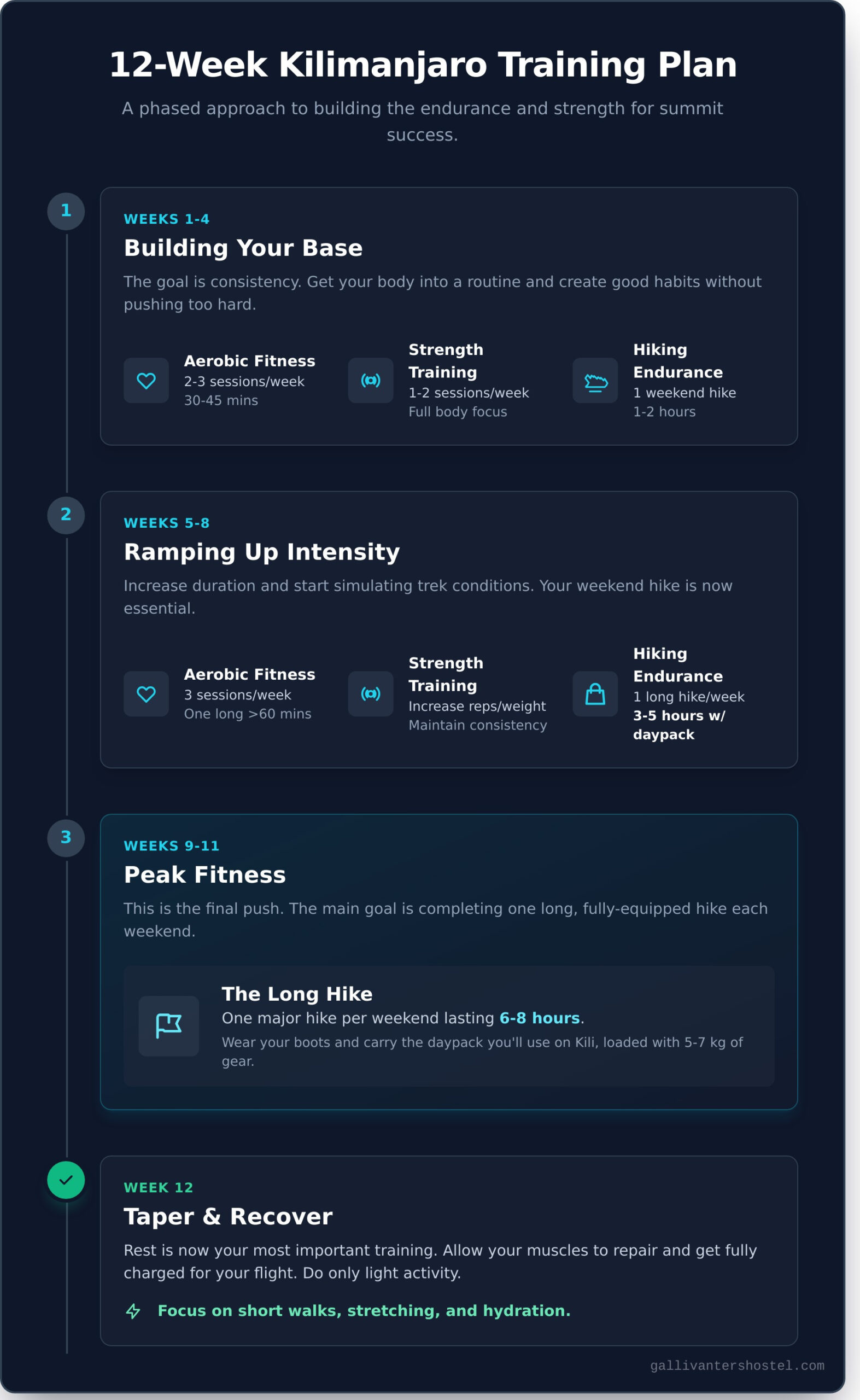
Ready to get started? Here is your week-by-week guide. Remember to be flexible and listen to your body—rest is just as important as training! We’ve broken it down into three simple, four-week phases. ✅
Phase 1: Building Your Base (Weeks 1-4)
The goal of this first month is to get your body into a consistent routine. Don’t push too hard; just focus on creating good habits. Aim for 2-3 cardio sessions of 30-45 minutes each week. Add 1-2 basic strength training sessions focusing on full-body movements. If you can, get out for a short walk or easy hike on the weekend for 1-2 hours.
Phase 2: Ramping Up the Intensity (Weeks 5-8)
Now that you have a solid base, it’s time to start increasing the duration and simulating the trek more seriously. Aim for 3 cardio sessions per week, with one of them being a longer session of 60 minutes or more. In your strength workouts, try to increase the weight or number of repetitions. Your weekend hike is now essential. Aim for 3-5 hours on the trail and start carrying a light daypack with some water and a jacket inside.
Phase 3: Peak and Taper (Weeks 9-12)
This is the final push! In weeks 9, 10, and 11, you’ll reach your peak fitness. Your main goal is to complete one long hike each weekend, lasting 6-8 hours. Make sure you wear your hiking boots and carry the daypack you plan to use on Kilimanjaro, loaded with about 5-7 kg of gear. Week 12 is your taper week. It’s all about recovery. Do only light activity like short walks and stretching. This allows your muscles to repair and get fully charged for your flight. Rest is crucial! Ready to put your training to the test? Check out our Kili climbs!
Essential Training Tips That Make a HUGE Difference
A few pro tips from our guides and experienced climbers to give you an edge on the mountain.
Break In Your Hiking Boots. Seriously.
This is non-negotiable. Never, ever attempt to climb Kilimanjaro in a brand-new pair of boots. Blisters are one of the most common and preventable reasons people struggle on the trek. Wear your boots everywhere—on your training hikes, to the grocery store, and around the house. You want them to feel like a comfortable extension of your feet.
Train With Your Daypack
On the mountain, you’ll be carrying a daypack with 5-7 kg (11-15 lbs) of essentials like water, snacks, and layers. Your body needs to get used to this! During your training hikes in Phase 2 and 3, load up your pack with the gear you plan to bring. This prepares your back, shoulders, and core muscles for the real deal and helps you figure out how to adjust your pack for maximum comfort.
Hydration is Everything
Staying hydrated is one of the best ways to prevent altitude sickness. Your body will need a lot more water at high altitude than you’re used to. Practice drinking at least 3-4 liters of water during your long training hikes. This gets your body accustomed to processing high fluid intake, so it feels normal on the mountain.
Frequently Asked Questions
Do I really need to go to a gym to train for Kilimanjaro?
Not at all! You can build all the fitness you need without a gym membership. For cardio, you can run, jog, or cycle outside. For strength, bodyweight exercises like squats, lunges, push-ups, and planks are incredibly effective. The most important training—hiking—is done outdoors!
What if I live in a flat area with no hills or mountains to hike?
No hills? No problem! You can simulate incline training by finding a tall building and walking up and down the stairs. A stair-climbing machine at a local gym is also a fantastic option. Even walking on a treadmill with the incline set high will help prepare your legs for the uphill climb.
How important is training for preventing altitude sickness?
While excellent fitness doesn’t make you immune to Acute Mountain Sickness (AMS), it helps tremendously. A strong cardiovascular system is more efficient at using oxygen. More importantly, when your body isn’t struggling with the physical exertion of hiking, it has more resources to adapt to the lower oxygen levels, reducing the severity of AMS symptoms.
What’s the single most important exercise I can do?
Long-distance walking or hiking. Nothing prepares you for walking up a mountain better than… well, walking! It builds specific muscle endurance, strengthens your joints for the terrain, and gets you used to spending hours on your feet. If you can only do one thing, make it a long weekend hike.
Is it possible to train in less than 12 weeks?
Yes, especially if you already have a good baseline of fitness. If you’re starting with less time, focus on consistency and prioritize the long weekend hikes. However, giving yourself 12 weeks allows for a safer, more gradual build-up, which reduces the risk of injury and gives you more confidence.
You have the dream, and now you have the plan. Getting physically and mentally ready is part of the adventure, and every step you take in training is a step closer to the summit. At Gallivanters, we see travelers just like you start their journey from our hostel every single week. We know what it takes, and we’re here to help you succeed. Your Kilimanjaro adventure starts here. Book your climb!


